Part of: Chinese export silver
The shou symbol is the Chinese character 壽 (shòu), which means long life. It is one of the most used blessings in Chinese art, carved, painted and embroidered onto furniture, porcelain, jade, silver and textiles to wish the owner a long and healthy life. It often appears in a round form, worked into a circular medallion, or in a tall, upright form.
Own a Chinese piece with shou decoration?
Free, no obligation, returned at our cost if you decline.

- Read our Google reviews (opens Google)
- Free, no obligation
- A reply within one working day
- Paid the same day after inspection
What does shou mean in Chinese?
壽 (shòu) means longevity, or long life. It is also used for a person’s age and for a birthday, above all the birthday of an older person: a 60th, 70th or 80th birthday is a "shou" celebration. As a decorative motif, the character is a wish: whoever owns or receives the object should live a long life.
Shou is one of the Three Blessings, Fu Lu Shou: fú 福 (good fortune), lù 祿 (rank and prosperity) and shòu 壽 (long life). In art they appear as three robed figures, the Three Star Gods. Shouxing, the god of long life, is an old man with a high, domed forehead, holding a peach and a staff, often with a crane or a deer beside him.
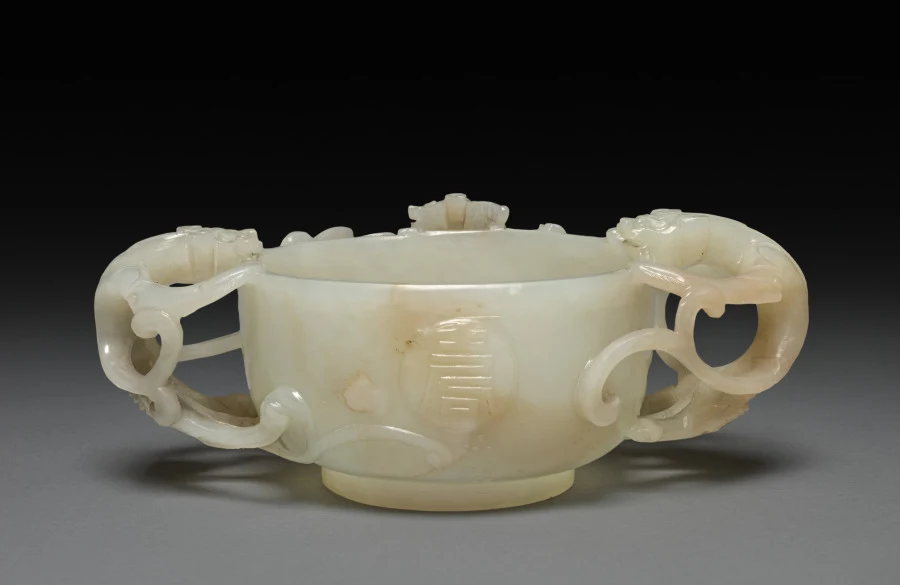
The round shou and the long shou
The character is drawn in two main ways in decoration.
- Round shou
- Chinese
- 團壽 tuán shòu
- How it looks
- The character compressed into a circle, almost a geometric medallion
- Where you see it
- Porcelain roundels, robe and textile medallions, carved furniture panels, silver
- Long shou
- Chinese
- 長壽 cháng shòu
- How it looks
- The character drawn tall and upright
- Where you see it
- Scrolls, vase decoration, borders on textiles and silver
A famous birthday gift is the bǎi shòu tú 百壽圖, "a hundred shou": the character written in a hundred different scripts on one scroll or panel.
The symbols that go with shou
Shou is rarely alone. These companions confirm that a design is about long life:
- Bats. The word for bat, fú 蝠, sounds like fú 福, good fortune. Five bats circling a shou character, wǔ fú pěng shòu 五福捧壽, wishes the Five Blessings: long life, wealth, health, love of virtue and a peaceful death in old age.
- Peaches. The peach is the fruit of immortality in Chinese legend.
- Cranes, pine trees, deer and tortoises. Each is a long-life symbol in its own right.
- Lingzhi fungus. The "fungus of immortality", often shaped into scrolls around the character.
Where shou appears on antiques
- Porcelain: round shou medallions on bowls, dishes and vases, in underglaze blue or in coloured enamels, often with bats and peaches.
- Jade and hardstone: pendants and plaques carved as a round shou.
- Textiles: embroidered medallions on robes and hangings made for birthdays.
- Furniture: carved or inlaid panels on cabinets, screens and tables, like the campaign table fragment shown here.
- Silver: Chinese export silver often carries shou medallions among dragons, bamboo or prunus.
How to read a shou piece
0 of 4 checked
1Look for the circle
A symmetrical round medallion, built from strokes rather than a picture, is very often a round shou.
2Look for the companions
Bats, peaches, cranes or pine next to it point to a long-life design.
3Look at the base
Reign marks on porcelain were copied for centuries, so a mark is a starting point, not proof of age.
4Look at the making
Crisp carving, even enamel and fine casting matter more than the motif itself.
Own a Chinese piece with shou decoration? Send clear photographs of the front, the back and any marks for a free, honest check.
Free, no obligation, returned at our cost if you decline.
Does the shou symbol make a piece valuable?
The motif itself is common: shou was used on imperial commissions and on everyday wares alike. What matters is the material, the age, the quality of the carving or painting, any marks, the condition and the provenance. We never publish figures; every piece is different.
Free, no obligation, and returned at our cost if you decline.
Read our Google reviews (opens Google)
- Material
- Age
- Workmanship
- Marks
- Condition
- Provenance
How selling works
- 1
Send photographs
of the front, the back and any marks, plus anything you know about where it came from.
- 2
Free value inspection
We reply within one working day with an estimate, subject to inspection. If our offer differs, you can decline and we return it at our cost.
- 3
Paid the same day after inspection
by bank transfer or in cash, in Mayfair, at our Braintree office, by post or by free collection.
Questions people ask
What does shou mean in Chinese?
壽 (shòu) means long life, or longevity. It is also used for a person’s age and for birthdays, especially those of older people.
What does the shou symbol look like?
It is the character 壽. In decoration it is often drawn as a round medallion (tuán shòu) or as a tall, upright character (cháng shòu).
What are Fu Lu Shou?
The Three Blessings: fú (good fortune), lù (rank and prosperity) and shòu (long life). They are shown as three robed figures, the Three Star Gods.
Why are bats drawn around the shou symbol?
The word for bat, fú, sounds like the word for good fortune. Five bats around shou wish the Five Blessings: long life, wealth, health, love of virtue and a peaceful death in old age.
What is the Chinese symbol for longevity?
The character 壽 (shòu). Peaches, cranes, pine trees, deer, tortoises and the lingzhi fungus are long-life symbols too.
Is the shou symbol used in jewellery?
Yes. It appears on jade and hardstone pendants, gold and silver charms, buttons and Chinese export silver jewellery.
Related guides
Have a piece with Chinese decoration?
Send a few photographs and we will tell you what it is and what it is worth, free.
Free, no obligation, returned at our cost if you decline.